Skip to content
  • Home
  • About Us
  • Banking
    • Saving Account
  • Contact Us
  • Home
  • About Us
  • Banking
    • Saving Account
  • Contact Us
Nexo Insider Blog Banking Saving Account How to Open a High-Yield Savings Account.
  • Nexo Insider
  • How to Open a High-Yield Savings Account.

How to Open a High-Yield Savings Account.

  • By Nexo Insider
  • December 30, 2025
  • Banking, Saving Account
How to Open a High-Yield Savings Account.

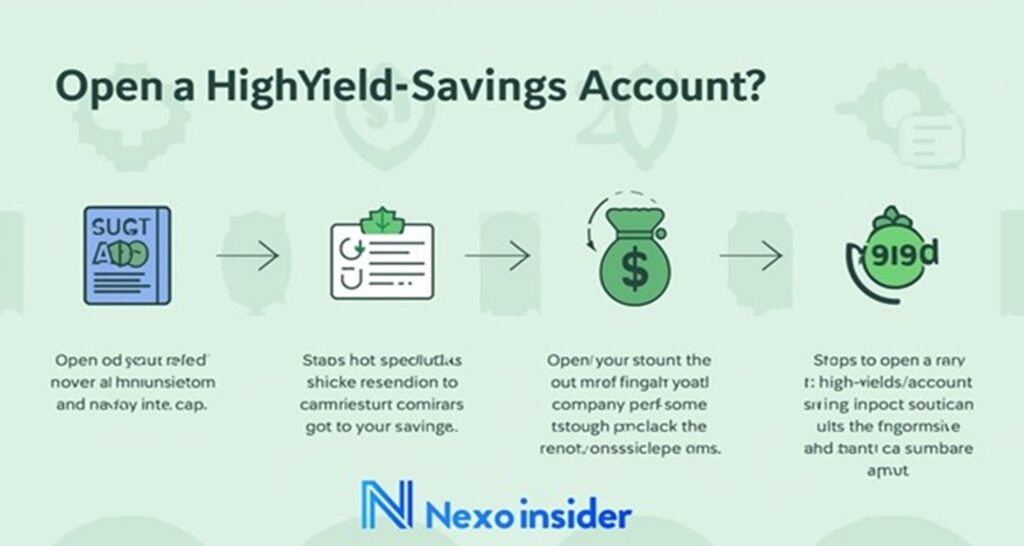
If you’re ready to make your cash work harder, opening a high-yield savings account (HYSA) is a smart move. these accounts offer much better interest rates than traditional savings, without locking your money away permanently. the process is straightforward, and we’ll walk you through it step by step.

1. Shop for the Best Rates & Terms

First up: comparison shopping. there are hundreds of banks and credit unions offering savings accounts these days. Your goal: find one with the highest Annual Percentage Yield (APY) coupled with reasonable terms and minimal fees.

When you’re comparing, keep an eye on:

  • Is the rate promotional or ongoing? Some banks lure you with a high initial rate that drops after a few months.
  • How often is interest compounded? The more frequently it compounds, the more you’ll earn.
  • What are the minimums or caps? Some accounts require a certain balance to earn the top rate, or restrict the amount eligible for the high rate.

And worth noting: Many of the best rates come from online banks since they don’t carry the overhead costs of physical branches.

2. Choose the Right Financial Institution

Once you have zeroed in on a few good rate-options, pick one that fits your preference and access needs.

  • You’re okay with an online-only bank, or prefer a physical branch for some visits.
  • The bank is FDIC-insured (or NCUA-insured for credit unions) so your deposits are protected up to the legal limit.
  • You can easily link your checking account to this savings account for quick transfers.
  • There are any sneaky fees or conditions (monthly maintenance, minimum balances, transfer restrictions) that might reduce your effective return.

If you find your current bank offers a competitive rate and you’re comfortable with it, you can stay put. But if you will earn far more elsewhere, opening a new account makes sense.

3. Complete the Application

With your institution picked, go ahead and open the account. These days the application process is quick — often around 10 minutes online.

Typical info you’ll need:

  • Full legal name, address, telephone, email.
  • Identification (driver’s license, passport, etc.)
  • Social Security Number (or Taxpayer Identification Number), so the bank can report your interest to the IRS if required.
  • Whether the account is in your name only or jointly with someone.

Some banks will let you open right online. Others (especially credit unions or local banks) may require a branch visit.

4. Fund Your New Account

Now you need to deposit money. This could be done via:

  • Transferring from an existing bank account.
  • Depositing a check (mobile deposit or in-person).
  • Some banks require a minimum opening deposit; others let you start with $0. either way, verify the terms for earning the best rate.

Linking your checking account makes future transfers smoother. Be sure to verify external account transfers (some banks use micro-deposits to confirm).

5. Set Up Online Banking & Alerts

To get the most out of your HYSA:

  • Enroll in the bank’s online portal or mobile app immediately.
  • Download the app and log in. set strong passwords or use multi-factor authentication.
  • Set alerts for things like large withdrawals, low balance thresholds, or unusual activity. this helps protect your account and ensures you’re staying on track.
  • Opt-in for e-statements (many online banks offer this and it’s more convenient).

6. Link Additional Accounts & Automate Transfers

To make your HYSA even more effective:

  • Link one or more external checking accounts so you can move money in/out seamlessly.
  • Set up automatic transfers — for example, each payday you move $200 into your HYSA. It’s an easy way to build savings without thinking about it.
  • By separating your “spending” account (checking) and your “saving” account (HYSA), you also reduce temptation to dip into your savings early.

7. Know and Follow the Account Rules

Even though you’re earning a great rate, you’ll want to stay mindful of the account’s specific rules so you don’t accidentally reduce your earnings via fees:

  • Check minimum balance requirements to get the advertised rate.
  • Note any withdrawal limits. While federal rules changed, some savings accounts still limit the number of certain types of transfers per month.
  • Look out for any monthly service fees, can they be waived? what do you need to do?
  • If you plan to keep the account long term, ensure you still meet the conditions (if any) for maintaining the rate.

Final Thought

Opening a high-yield savings account is one of the smartest, simplest ways to get more from your money, especially cash that you’re holding for the short term (emergency fund, major purchase, down payment). with careful selection of rate, bank, and setup, you will earn significantly more than leaving that cash in a standard savings or checking account.

It takes only a few minutes to open, a little bit of setup to fund and link accounts, and then you can let the interest do its work. Just keep an eye on fees and rules, and you’ll benefit from better growth while maintaining easy access to your funds.

Leave feedback about this Cancel Reply

  • Quality
  • Price
  • Service

PROS

+
Add Field

CONS

+
Add Field
Choose Image
Choose Video

Recent Posts

  • by Nexo Insider
  • December 17, 2025

What Is a Savings Club? How These Group Saving Systems Work

Banking Saving Account
  • by Nexo Insider
  • December 18, 2025

What Is a Savings Account?

Banking Saving Account
  • by Nexo Insider
  • December 18, 2025

Money Market Account vs Savings Account: Which One Should You Pick?

Banking Saving Account
  • by Nexo Insider
  • December 18, 2025

How to Get the Best Savings Interest Rates for Your Money

Banking Saving Account
  • by Nexo Insider
  • December 19, 2025

Understanding Health Savings Accounts (HSA): What You Need to Know?

Banking Saving Account
  • by Nexo Insider
  • December 19, 2025

Should You Open a Foreign Savings Account? What You Should Know

Banking Saving Account

Follow Us

Instagram Facebook Threads Pinterest X-twitter Linkedin

Recent Articles

What Is a Merchant Bank? Functions, Services, and Real-World Examples

What Is a Merchant Bank? Functions, Services, and Real-World Examples

January 30, 2026

When you think of a bank, you might imagine the place where you deposit your paycheck, apply for a credit card, or

What Is a Financial Institution?

What Is a Financial Institution?

January 30, 2026

Financial institutions (FIs) are the backbone of the global economy. whether you are depositing money into a savings account, applying for a

Bank Account Number What It Is and How It Works

Bank Account Number What It Is and How It Works

January 30, 2026

Bank account number is crucial for managing your finances, securing money and preventing fraud. Digital world, banking has shifted from checkbooks to

How Do Commercial Banks Work and Why Do They Matter?

How Do Commercial Banks Work and Why Do They Matter?

January 30, 2026

Commercial bank are important in the finance. whether you’re depositing your paycheck, applying for a mortgage, or simply swiping your debit card at

FedNow: What It Is and How It Works

FedNow: What It Is and How It Works

January 30, 2026

The Federal Reserve made headlines in July 2023 when it launched FedNow, a groundbreaking instant payment service designed to transform the way

What Happened at Credit Suisse, and Why Did It Collapse?

What Happened at Credit Suisse, and Why Did It Collapse?

January 30, 2026

The collapse of Credit Suisse, one of Switzerland’s most prestigious and long-standing financial institutions, shocked the global banking industry in March 2023.

Tier 1 Capital Ratio: Understanding the Backbone of Banking Stability

Tier 1 Capital Ratio: Understanding the Backbone of Banking Stability

January 30, 2026

When we talk about the strength of a bank, there is one number that regulators, investors, and even governments look at closely—the

What Are Residential Mortgage-Backed Securities (RMBS)? Benefits and Risks

What Are Residential Mortgage-Backed Securities (RMBS)? Benefits and Risks

January 30, 2026

Residential Mortgage-Backed Securities (RMBS) are important financial instruments link the housing market with global investors. by pooling together residential mortgages, these securities give

Deposit: Definition, Meaning and Types.

January 29, 2026

When you hear the word deposit, it might bring to mind that moment when you hand over money at a bank, leave

APR vs. APY: What’s the Difference?

January 29, 2026

When it is comes to personal finance, APR (Annual Percentage Rate) & APY (Annual Percentage Yield) are two that confuse people. both involve interest,

Native American-Owned Banks by State

January 29, 2026

When we talk about financial inclusion in America, one often-overlooked yet vital component is the role of Native American-owned banks and credit

Choosing a New Bank? Consider These Factors First

January 29, 2026

Selecting a bank may seem straightforward, but it can significantly influence your financial well-being. the right bank helps you save money, earn

Banking Saving Account

What Is a Savings Club? How These Group Saving Systems Work

A savings club is an informal or formal savings arrangement where individuals contribute money regularly into a shared pool with.

  • December 17, 2025
  • 4 minutes read
Banking Saving Account

What Is a Savings Account?

A savings account is one of the simplest and most foundational financial tools anyone can use to protect and grow.

  • December 18, 2025
  • 4 minutes read
Money Market Account vs Savings Account
Banking Saving Account

Money Market Account vs Savings Account: Which One Should You Pick?

When you’re deciding where to park your hard-earned cash, the financial landscape sure offers plenty of choices. Two popular options.

  • December 18, 2025
  • 4 minutes read
  • Home
  • About Us
  • Contact Us
  • Disclaimer
  • Privacy Policy
  • Terms & Condition
© 2026 Nexo Insider All Rights Reserved.
Go to mobile version