Skip to content
  • Home
  • About Us
  • Banking
    • Saving Account
  • Contact Us
  • Home
  • About Us
  • Banking
    • Saving Account
  • Contact Us
Nexo Insider Blog Banking Saving Account Savings vs IRA: Which Is Better for Your Financial Future?
  • Nexo Insider
  • Savings vs IRA: Which Is Better for Your Financial Future?

Savings vs IRA: Which Is Better for Your Financial Future?

  • By Nexo Insider
  • December 19, 2025
  • Banking, Saving Account
Which Is Better for Your Financial Future

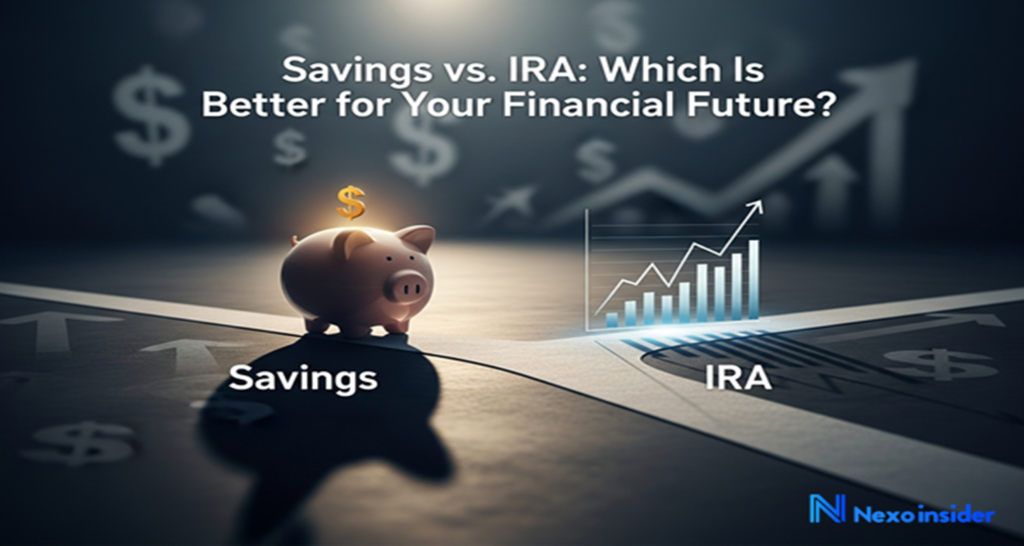
When it comes to putting money aside for the future, most people default to what they already know, a regular bank savings account, but for longer-term growth, especially retirement savings, another powerful option exists: the Roth IRA, understanding the key differences between a savings account and a Roth IRA can help you make smarter financial decisions that align with your goals.

What Is a Savings Account?

A savings account is a basic bank account designed to hold cash while earning a small amount of interest. You can open one at a bank or credit union, and from there, your money stays liquid, meaning you can access it any time without tax or penalty.

The major perks of a savings account are:

Easy access: You can withdraw money whenever you need it.

Safety: Most savings accounts are insured up to $250,000 by the FDIC or NCUA, so your funds are protected even if the bank fails.

Simple growth: Your balance earns interest, which is typically low but steady.

That said, this kind of account is best for short-term goals, like building an emergency fund or saving for a big purchase in the next year or two, savings accounts aren’t built to grow your wealth rapidly, and they usually don’t beat inflation over decades.

An Introduction to Roth IRAs


A Roth IRA (Individual Retirement Account) is a retirement-focused account with special tax advantages. Unlike a savings account, a Roth IRA is not just cash parked in a bank, it is usually invested in things like stocks, bonds, mutual funds, and other assets that have potential to grow significantly over time.

Here’s what makes a Roth IRA so powerful:

Tax-free growth: You contribute money after you’ve paid taxes on it, then, when you retire and start taking withdrawals, the earnings you’ve made over the years can come out tax-free, as long as you follow IRS rules (like keeping the account open for at least five years and being 59½ or older).

No required withdrawals:
Unlike some retirement accounts, a Roth IRA doesn’t force you to start withdrawing at a certain age. You can let your investments grow as long as you want.

Flexible investment choices: Within a Roth IRA, you can choose from many types of investments — from index funds and ETFs to CDs and more.

A Roth IRA is really built for long-term growth rather than quick access, there are annual contribution limits set by the IRS (for example, $7,000 in 2025 for most people).

Savings Account vs Roth IRA: Key Differences

1. Liquidity — How Easily Can You Access Your Money?

One of the biggest differences is how accessible your funds are.

  • Savings Account: Constant access. You can deposit and withdraw whenever you want.
  • Roth IRA: You can withdraw your original contributions at any time without penalties, but tapping into earnings early may result in taxes or penalties.

If easy access matters most — especially for an emergency fund — a savings account is the clear winner.

2. Growth and Investment Potential

  • Savings Accounts: Offer modest interest rates that rarely beat inflation. While safe, they won’t grow much over decades.
  • Roth IRAs: Can invest in markets that historically grow faster than bank interest rates, giving you a better chance to build wealth over time.

If your focus is long-term growth and compounding gains, a Roth IRA has a huge advantage — especially with its tax-free benefits.

3. Taxes and Returns

  • Savings Account Interest: Taxable in the year you earn it, just like regular income.
  • Roth IRA Growth: Tax-free at retirement if conditions are met, meaning more of your returns stay in your pocket.

This tax treatment makes Roth IRAs particularly attractive for long-term wealth building.

When to Use Each Account

Best Uses for a Savings Account

  • Emergency fund (3–6 months of living costs)
  • Soon-term goals (vacation, upcoming bills)
  • Keeping cash secure without market risk

Savings accounts are ideal if you value liquidity and safety over growth.

Best Uses for a Roth IRA

  • Long-term retirement savings
  • Investing for growth with tax advantages
  • Letting earnings compound over many years

Roth IRAs are perfect for building long-term wealth and reducing your tax burden in retirement.

Combining Both for Smart Financial Planning

Here’s a strategy many financial pros recommend: use both. Keep an emergency fund in a savings account while funding your Roth IRA for long-term growth. This way, your short-term needs are covered without sacrificing the future potential of your retirement nest egg.

Final Thought

Both savings accounts and Roth IRAs serve distinct financial purposes, savings account gives you quick, secure access to cash whenever you need it, while a Roth IRA offers powerful tax advantages and growth potential for retirement, your best choice depends on your financial goals and timeline, and the truth is, the smartest plan usually includes both tools working together, whether you are building an emergency cushion or investing for the future, understanding the difference between these account types is key to mastering your money.

Leave feedback about this Cancel Reply

  • Quality
  • Price
  • Service

PROS

+
Add Field

CONS

+
Add Field
Choose Image
Choose Video

Recent Posts

  • by Nexo Insider
  • December 17, 2025

What Is a Savings Club? How These Group Saving Systems Work

Banking Saving Account
  • by Nexo Insider
  • December 18, 2025

What Is a Savings Account?

Banking Saving Account
  • by Nexo Insider
  • December 18, 2025

Money Market Account vs Savings Account: Which One Should You Pick?

Banking Saving Account
  • by Nexo Insider
  • December 18, 2025

How to Get the Best Savings Interest Rates for Your Money

Banking Saving Account
  • by Nexo Insider
  • December 19, 2025

Understanding Health Savings Accounts (HSA): What You Need to Know?

Banking Saving Account
  • by Nexo Insider
  • December 19, 2025

Should You Open a Foreign Savings Account? What You Should Know

Banking Saving Account

Follow Us

Instagram Facebook Threads Pinterest X-twitter Linkedin

Recent Articles

What Is a Merchant Bank? Functions, Services, and Real-World Examples

What Is a Merchant Bank? Functions, Services, and Real-World Examples

January 30, 2026

When you think of a bank, you might imagine the place where you deposit your paycheck, apply for a credit card, or

What Is a Financial Institution?

What Is a Financial Institution?

January 30, 2026

Financial institutions (FIs) are the backbone of the global economy. whether you are depositing money into a savings account, applying for a

Bank Account Number What It Is and How It Works

Bank Account Number What It Is and How It Works

January 30, 2026

Bank account number is crucial for managing your finances, securing money and preventing fraud. Digital world, banking has shifted from checkbooks to

How Do Commercial Banks Work and Why Do They Matter?

How Do Commercial Banks Work and Why Do They Matter?

January 30, 2026

Commercial bank are important in the finance. whether you’re depositing your paycheck, applying for a mortgage, or simply swiping your debit card at

FedNow: What It Is and How It Works

FedNow: What It Is and How It Works

January 30, 2026

The Federal Reserve made headlines in July 2023 when it launched FedNow, a groundbreaking instant payment service designed to transform the way

What Happened at Credit Suisse, and Why Did It Collapse?

What Happened at Credit Suisse, and Why Did It Collapse?

January 30, 2026

The collapse of Credit Suisse, one of Switzerland’s most prestigious and long-standing financial institutions, shocked the global banking industry in March 2023.

Tier 1 Capital Ratio: Understanding the Backbone of Banking Stability

Tier 1 Capital Ratio: Understanding the Backbone of Banking Stability

January 30, 2026

When we talk about the strength of a bank, there is one number that regulators, investors, and even governments look at closely—the

What Are Residential Mortgage-Backed Securities (RMBS)? Benefits and Risks

What Are Residential Mortgage-Backed Securities (RMBS)? Benefits and Risks

January 30, 2026

Residential Mortgage-Backed Securities (RMBS) are important financial instruments link the housing market with global investors. by pooling together residential mortgages, these securities give

Deposit: Definition, Meaning and Types.

January 29, 2026

When you hear the word deposit, it might bring to mind that moment when you hand over money at a bank, leave

APR vs. APY: What’s the Difference?

January 29, 2026

When it is comes to personal finance, APR (Annual Percentage Rate) & APY (Annual Percentage Yield) are two that confuse people. both involve interest,

Native American-Owned Banks by State

January 29, 2026

When we talk about financial inclusion in America, one often-overlooked yet vital component is the role of Native American-owned banks and credit

Choosing a New Bank? Consider These Factors First

January 29, 2026

Selecting a bank may seem straightforward, but it can significantly influence your financial well-being. the right bank helps you save money, earn

Banking Saving Account

What Is a Savings Club? How These Group Saving Systems Work

A savings club is an informal or formal savings arrangement where individuals contribute money regularly into a shared pool with.

  • December 17, 2025
  • 4 minutes read
Banking Saving Account

What Is a Savings Account?

A savings account is one of the simplest and most foundational financial tools anyone can use to protect and grow.

  • December 18, 2025
  • 4 minutes read
Money Market Account vs Savings Account
Banking Saving Account

Money Market Account vs Savings Account: Which One Should You Pick?

When you’re deciding where to park your hard-earned cash, the financial landscape sure offers plenty of choices. Two popular options.

  • December 18, 2025
  • 4 minutes read
  • Home
  • About Us
  • Contact Us
  • Disclaimer
  • Privacy Policy
  • Terms & Condition
© 2026 Nexo Insider All Rights Reserved.
Go to mobile version