When it comes to finance, politics, and economics, the terms hard money and soft money appear frequently—but their meanings differ depending on the context. While many people associate these terms strictly with U.S. campaign finance, they actually extend far beyond politics. in economics, hard money represents physical currency tied to precious metals, while soft money typically refers to paper or fiat currency. in finance, the terms can also describe how clients pay brokers. And in real estate, hard money refers to a very specific kind of short-term loan.
Introduction to Hard Money vs. Soft Money
The terms hard money and soft money can be tricky because they change meaning depending on the industry. At a glance:
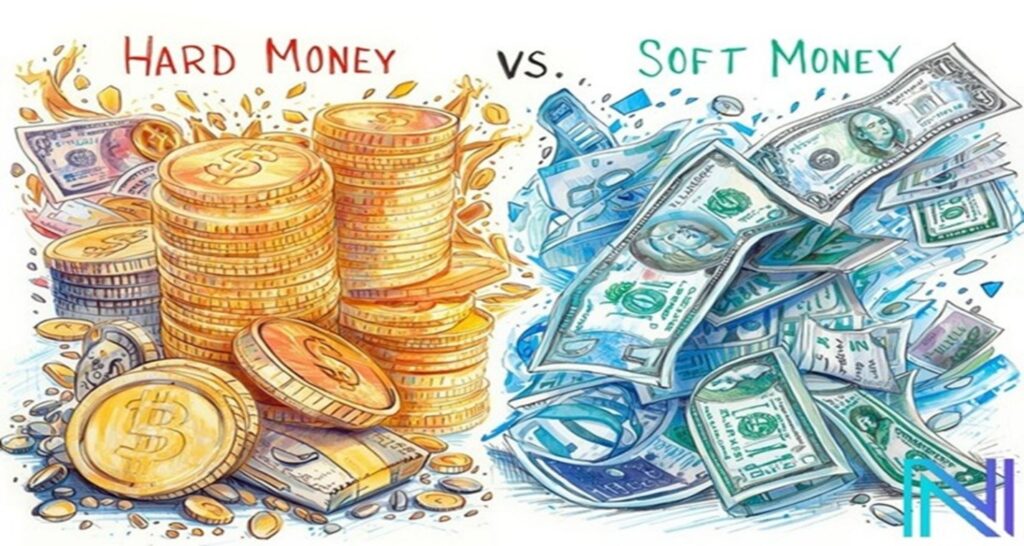
- In economics, hard money refers to money backed by precious metals, while soft money refers to fiat or paper currency.
- In politics, hard money is direct, regulated donations to candidates, while soft money is indirect, often unregulated funding to parties or PACs.
- In finance, hard money means direct payments for services, whereas soft money includes indirect payments like free research or perks.
- In real estate, a hard money loan is a short-term loan secured by property, often used by investors.
Hard Money in Economics
Hard money represents currency that has intrinsic value or is backed by a tangible asset, gold or silver. nations that used a gold standard were operating on a hard money basis.
Key Features of Hard Money in Economics:
- Precious metals like gold and silver.
- Limited supply, excessive inflation.
- Stable value compared to fiat currency.
- Protects against government overprinting.
Soft Money in Economics
Soft money in economics usually refers to fiat currency—money not backed by a physical commodity but instead by government regulation and trust. Most modern economies today operate on soft money systems.
Key Features of Soft Money in Economics:
- Not backed by tangible assets.
- Easily expandable by central banks.
- Can lead to inflation if mismanaged.
- Offers government in monetary policy.
The USA dollar today is considered soft money since it’s not tied to gold or silver but rather the full faith and credit of the U.S. government. This allows the Federal Reserve to expand or contract the money supply as needed to manage inflation, unemployment, and economic growth.
Hard Money in Campaign Finance
In U.S. politics, hard money refers to direct contributions to a political candidate’s campaign. These contributions are tightly regulated by the Federal Election Commission (FEC).
Key Features of Hard Money in Politics:
- Donated directly to a candidate.
- Strict limits apply to how much can be donated.
- Contributions come individuals or PACs.
- Funds must be reported and fully transparent.
For example, during the 2023–2024 election cycle, a donor could only contribute $3,300 per candidate, per election.
Soft Money in Campaign Finance
Soft money in politics refers to indirect contributions made to political parties or political action committees (PACs) rather than directly to candidates.
Key Features of Soft Money in Politics:
- Donated to political parties or PACs, not candidates.
- Historically no strict limits on donation amounts.
- Can come from individuals, PACs, or even corporations.
- Officially intended for “party-building activities” like voter registration or issue advocacy.
Shift came with the Citizens United vs FEC (2010) Supreme Court ruling, which allowed unlimited soft money donations under the protection of free speech. this gave rise to Super PACs, which can raise and spend unlimited amounts as long as they are not directly controlled by candidates.
Contribution Limits for Hard Money
The FEC sets strict contribution limits to maintain fairness in elections. For the 2023–2024 federal election.
| Contribution Type | Limit |
| To each candidate per election | $3,300 |
| To national party committee per year | $41,300 |
| To state, district, or local party committees (combined) | $10,000 |
| To any other political committee | $5,000 |
These restrictions ensure candidates cannot rely excessively on a single wealthy donor and promote transparency in campaign funding.
The Soft Money Loophole in Politics
The soft money loophole refers to the ability of donors especially corporations and wealthy individuals—to contribute unlimited funds to parties or Super PACs, bypassing hard money restrictions.
While the Bipartisan Campaign Reform Act of 2002 (McCain-Feingold Act) attempted to curb soft money use, the Citizens United decision reopened the door for unlimited donations. critics argue this gives disproportionate power to wealthy donors and corporations, raising concerns about corruption and unequal influence in politics.
Hard Money in Brokerage and Financial Services
In finance, hard money often means direct payments clients make to their brokers for services rendered—such as commissions on trades.
On the other hand, soft money can refer to indirect benefits, such as a broker providing research, reports, or services without direct charges, often covered by transaction costs.
While common, soft money arrangements are often criticized for lacking transparency since stakeholders may not know the true cost of such perks.
Hard Money Loans in Real Estate
A hard money loan is an asset-backed loan, used by investors who need quick financing.
Key Features of Hard Money Loans:
- Secured by property value rather than credit score.
- Short-term (usually 6–24 months).
- Higher interest rates compared to traditional loans.
- Flipping houses or financing commercial projects.
Advantages and Disadvantages of Hard Money
Advantages:
- Transparency (in politics and finance).
- Stability (in economics when tied to gold/silver).
- Quick access to funds (in real estate).
Disadvantages:
- Strict regulations and limits (in campaign finance).
- Higher interest rates (in real estate).
- Less flexibility in monetary policy (in economics).
Soft Money: Benefits and Criticisms
Benefits:
- Flexibility for governments to manage economies.
- Unlimited fundraising for parties and PACs.
- Support for voter education and registration efforts.
Criticisms:
- Lack of transparency in political funding.
- Risk of inflation in economics.
- Potential conflicts of interest in financial services.
Key Differences Between Hard Money and Soft Money
To summarize, here are the main distinctions across different contexts:
| Context | Hard Money | Soft Money |
| Economics | Currency backed by gold/silver | Fiat paper currency |
| Politics | Direct candidate contributions (regulated) | Indirect party/PAC contributions (less regulated) |
| Finance | Direct payments (commissions) | Indirect perks (research, services) |
| Real Estate | Asset-backed short-term loans | Not commonly used |
The Bottom Line
while hard money emphasizes structure, transparency, and limitation, soft money represents flexibility, expansion, and sometimes less oversight. both concepts are crucial in understanding how money impacts economies, financial systems, and political campaigns.