Banking is back backbone of every economy. whether you are an individual managing personal finances or a business handling multi-million-dollar transactions, banks play a critical role in safeguarding money, enabling credit, and supporting financial growth.
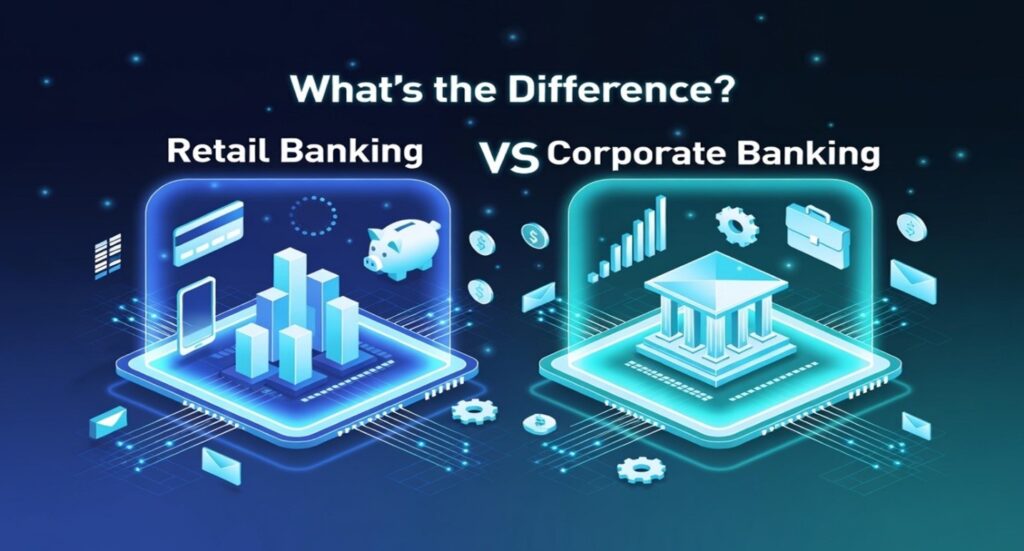
Both fall under the umbrella of commercial banking, retail banking is primarily concerned with individual consumers and households, while corporate banking provides financial services to companies and large organizations.
What Is Retail Banking?
Retail banking, known for consumer banking or personal banking, refers to financial services offered to the general public. services help individuals manage your day-to-day financial needs, save for future or access credit when required.
Retail banking is the public face of banking, often experienced through:
- Physical bank branches
- ATMs (Automated Teller Machines)
- Mobile banking apps
- Online banking platforms
In short, retail banking is designed to meet the financial needs of individuals and families.
Key Services Offered by Retail Banks
- Checking and Savings Accounts – Everyday accounts that allow individuals to store, transfer, and access money.
- Certificates of Deposit (CDs) – Investment products that lock funds for a set time in exchange for higher interest rates.
- Mortgages – Long-term loans for purchasing residential property.
- Personal Loans and Credit Lines – Home equity lines of credit (HELOCs).
- Credit Cards – For everyday purchases, emergency expenses, and credit-building.
- Automobile Financing – Loans for purchasing vehicles.
- Foreign Currency Exchange & Remittances – Helping individuals transfer money abroad.
Who Uses Retail Banking?
Retail banking serves:
- Everyday consumers with modest banking needs.
- Students and young professionals opening their first accounts.
- Families managing mortgages and household expenses.
- High-net-worth individuals (HNWI) who receive personalized services like private banking and wealth management.
Technology’s Role in Retail Banking
Retail banking has undergone a significant digital transformation in the last two decades.
- Transfer funds instantly.
- Deposit checks remotely.
- Pay bills online.
- Apply for loans digitally.
What Is Corporate Banking?
Corporate banking emerged as a separate discipline in the United States after Glass-Steagall Act of 1933, which divided commercial and investment banking. Though the act was repealed in the late 1990s, the distinction between corporate banking and retail banking still remains relevant today.
Unlike retail banking, which serves millions of individual customers, corporate banking deals with fewer but larger clients who require specialized services.
Key Services Offered by Corporate Banks
Corporate banks provide businesses with financial tools to operate, grow, and manage risk. Common services include:
- Business Loans and Credit Facilities – To finance operations, purchase assets, or expand.
- Treasury and Cash Management Services – Helping businesses manage liquidity and optimize working capital.
- Commercial Real Estate Financing – Loans for office spaces, factories, or warehouses.
- Equipment Financing – Leasing or loans for machinery, vehicles, or technology.
- Trade Finance – Facilitating international trade through letters of credit and export financing.
- Employer Service – Payroll management, employee benefits, and pension accounts.
- Investment Banking Services – Such as securities underwriting, mergers & acquisitions (M&A), and asset management.
Who Uses Corporate Banking?
Corporate banking clients typically include:
- Medium enterprises (SMEs) needing capital to expand.
- Large corporations managing multi-billion-dollar operations.
- Government agencies and institutions treasury services.
- Nonprofits and organizations specialized financial products.
Unlike retail clients, corporate customers require customized financial solutions rather than one-size-fits-all products.
How Do Retail Banks Make Money?
Retail banks generate revenue through:
- Interest spreads: Between interest paid on deposits and interest charged on loans.
- Service fees: Charges on checking accounts, overdrafts, and ATM usage.
- Commissions from selling insurance, mutual funds, or investment products.
Retail banking profits rely heavily on volume, since millions of individual customers collectively generate significant revenue.
How Do Corporate Banks Make Money?
Corporate banking is often more profitable because of higher transaction values. Revenue sources include:
- Loan interest on large corporate loans.
- Service fees for treasury and cash management.
- Trade finance charges.
- Advisory fees from mergers, acquisitions, and investment banking services.
If a business defaults on a large loan, the financial loss can be significant.
The Importance of Banking in the Economy
Both retail and corporate banking are essential pillars of the economy:
- Retail banking supports consumer spending by providing credit, mortgages, and savings products.
- Corporate banking supports growth.
During the 2007–2008 global financial crisis, the failure of banks highlighted how deeply connected the banking system is to the world economy. when banks stop lending, both businesses and consumers suffer, leading to widespread economic slowdowns.
Key Differences Between Retail Banking and Corporate Banking
Here’s a quick comparison:
| Aspect | Retail Banking | Corporate Banking |
| Clients | Individual consumers & households | Businesses, corporations, and institutions |
| Services | Savings accounts, loans, mortgages, credit cards | Business loans, treasury services, trade finance, corporate accounts |
| Revenue Model | Interest spreads, service fees, credit card charges | Loan interest, advisory fees, trade finance income |
| Transaction Size | Typically small | Large, high-value transactions |
| Risk Level | Lower (diversified across many customers) | Higher (exposure to large clients) |
| Branch/Access | Branches, ATMs, mobile apps | Dedicated relationship managers, corporate banking divisions |
Benefits of Retail Banking
- Accessibility – Available to the general public.
- Convenience – Mobile and online banking make personal finance easy.
- Financial Security – Savings accounts and CDs protect money.
- Credit Access – Loans and credit cards help individuals achieve financial goals.
Benefits of Corporate Banking
- Credibility – A corporate account adds professionalism to a business.
- Better Financial Management – Treasury and cash management optimize liquidity.
- Growth Opportunities – Access to loans helps businesses expand.
- Investment Options – Corporate banking often includes wealth management and investment services.
- Liability Protection – Separation of personal and business accounts reduces risk.